
Miqat and the intention of a pilgrimage are connected to each other. In fact, observing Miqat and making niyyah is the foremost ritual of the pilgrimage either Hajj or Umrah.
But how does Miqat affect the validity of a pilgrimage? And how to observe Miqat boundaries when traveling by air? What if I missed Miqat without making niyyah? All of these are valid concerns that every pilgrim should understand. So, this blog post is all about the importance, locations and rules of Miqat in Islam for pilgrims. So, let's read ahead.
What does Miqat mean in Islam?
The word Miqat (مِيْقَات) comes from Arabic root wa-qa-ta which literally means to determine a specific time or place. In other words, Miqat is a fixed boundary. And in Islamic Shari'a, it's a specific time or place that Allah has set to begin certain acts of worship.
Specifically, the word Miqat refers to a boundary location that pilgrims can't cross without entering Ihram either for Umrah or Hajj. And crossing Miqat without entering Ihram is a major violation of a divine boundary that also invalidates the whole pilgrimage.
The Concept of Sacred Boundaries in Islam
Islam emphasizes on divine boundaries both physical and spiritual set by Allah. The purpose of setting these boundaries is to protect the sanctity of worship and test the obedience of believers. For example, Islamic Shari'a has set boundaries for prayer times and fasting hours. In a similar way, Miqat is a sacred boundary of pilgrimage.
As soon as pilgrims cross Miqat, this special boundary reminds them of a sacred location and worship in which one can't violate the sanctity of Ihram. Miqat also reminds pilgrims about revising the intention and making it sincere only for the sake of Allah. After all, there's a divine guidance about each step of the journey that hasn't to do anything with personal choices.
Miqat as a sacred boundary of pilgrimage (Sunnah Evidence)
An authentic Hadith of both Sahih al-Bukhari and Sahih Muslim stated that the Holy Prophet clearly mentioned different Miqat locations for pilgrims travelling from different regions to enter Ihram. It has also been mentioned that no one should cross the respective Miqat point without entering Ihram if intends to perform Umrah or Hajj.
So, it's clear that Miqat isn't a symbolic or optional boundary but an established obligation by the Sunnah. And all the scholars of different schools acknowledge the importance of Miqat as a valid obligation.
Types of Miqat in Islam
There are two main types of Miqat in Islam specifically for pilgrimage. The purpose of both these types is to prepare pilgrims for Hajj or Umrah. Hence the understanding of Miqat is important to perform pilgrimage in the right way.
Miqat Makani (Location-Based Boundary)
As the name shows, Miqat Makani is related to a specific geographical location. There are different designations of Miqat boundaries for people of different regions traveling to Makkah to perform pilgrimage. Miqat Makani guides pilgrims about where to enter into the Ihram state.
So, every pilgrim who intends to perform Umrah has to enter Ihram before crossing Miqat whether traveling by land, air or sea. And following this rule clearly depicts the respect of believers for sacred boundaries.
Miqat Zamani (Time-Based Boundary)
Miqat Zamani refers to the specific time for entering into the Ihram state. And this completely makes sense for Hajj as Miqat Zamani begins in the months of Shawwal, Dhul Qa'dah and the first ten days of Dhul Hijjah.
Though pilgrims can perform Umrah anytime, Miqat Zamani restricts entering Ihram for Umrah during the days of Hajj. In other words, Miqat Zamani guides pilgrims about when to enter Ihram to perform a valid pilgrimage.
Differences Between Miqat for Hajj and Umrah
No, Miqat Makani remains the same for both Hajj and Umrah pilgrims. However, Miqat Zamani differs for Hajj and Umrah as Hajj has a specific time of entering into the Ihram state.
But there's an exception too in the case of residents of Makkah. For example, the residents of Makkah have to leave the boundary of Haram to enter the Ihram state to perform Umrah. However, they can enter Ihram from Makkah city to perform Hajj.
Overall, the rules of Miqat differ on the basis of location of living and from where the pilgrim started the journey. So, let's understand all the basics and rulings ahead.
Five Sunnah Miqat Locations (Miqat Makani)
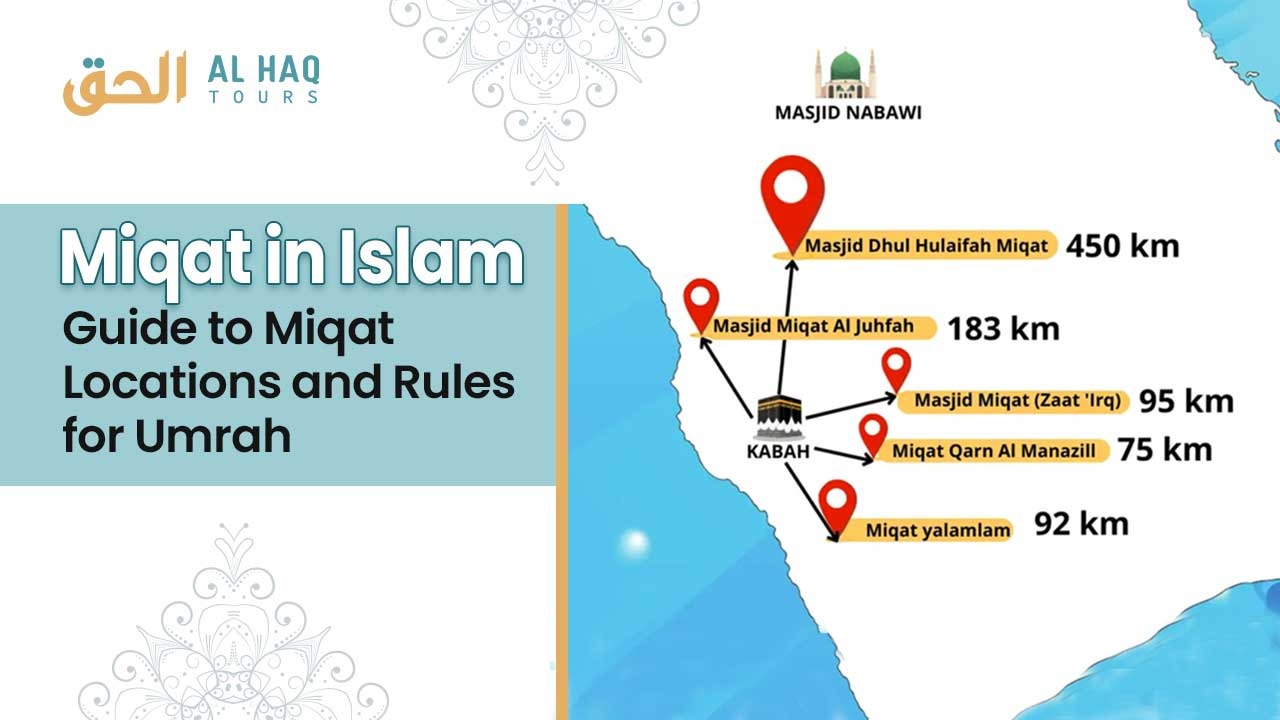
The holy Prophet prescribed five Miqat locations for pilgrims traveling from different regions to Makkah. These are Dhul Hulayfah, Al-Juhfah, Qarn al-Manazil, Yalamlam and Dhat Irq. Here's what belongs to which regions:
Dhul Hulayfah (Abyar Ali)
Dhul Hulayfah is a Miqat location in the north of Makkah at a distance of 450 km near Madinah. Nowadays, the Mosque Miqat Dhul Hulayfah represents this Miqat boundary having modern facilities for pilgrims. It's a specific Miqat for:
Residents of Madinah (Pilgrims traveling from Madinah to Makkah)
This is because Dhul Hulayfah is the farthest Miqat location than any other from Makkah. Pilgrims traveling from Madinah to perform Umrah or Hajj have to enter Ihram at this mosque.
The significance of this Miqat is huge as the Holy Prophet entered into the Ihram state at Dhul Hulayfah. And according to many scholars, entering Ihram at Dhul Hulayfah is a rewarding act. This is because of the distance from Makkah in which pilgrims remain in Ihram for longer and express more patience and mindfulness.
Al-Juhfah / Rabigh
Al-Juhfah was a Miqat near the Red Sea coast back in time. However, this original settlement became unsuitable for pilgrims over time because of severe deterioration. So, pilgrims enter Ihram from the nearby town "Rabigh" nowadays as an alternative Miqat.
The scholars also agree on the validity of Rabigh as an official Miqat substitute. And the facilities of mosques and rest areas are also available there for pilgrims.
Rabigh is a Miqat boundary for pilgrims traveling from Egypt, Sudan, North and West Africa, Europe and all the Western countries.
Qarn al-Manazil
Qarn al-Manazil is a Miqat boundary 75 kilometers in the east of Makkah. Pilgrims recognize this Miqat for its mountainous terrain near the city of Taif. Warn al-Manazil is a Miqat boundary for pilgrims traveling from:
- Najd
- Central Arabia
- Eastern regions
Qarn al-Manazil is the most widely used Miqat out there having a popular site "As-Sayl al-Kabir" there. This includes a large mosque, ablution areas and facilities for changing into Ihram.
Yalamlam
Yalamlam is another common Miqat point which is almost 100 kilometers away from Makkah. Pilgrims recognize this Miqat as an As-Sa'diyyah site full of mosques and restrooms. Yalamlam is a Miqat boundary for pilgrims traveling from:
- Yemen
- Southern Saudi Arabia
- South regions of indian subcontinent
Dhat Irq
Dhat Irq is the fifth Miqat boundary in the northeast of Makkah at 90 kilometers. According to many scholars, Caliph Hazrat Umar ibn al-Khattab (RA) designated this Miqat upon the guidance of the Holy Prophet. Dhat Irq is a Miqat boundary for pilgrims traveling from:
- Iraq
- Iran
- Northern regions beyond Najd
In short, all of these five Miqat locations are mandatory for pilgrims. So, they have to observe Miqat before crossing it. Similarly, the rules of Miqat apply to pilgrims on the basis of the direction of traveling for Makkah. For example, a citizen of any region will enter into the Ihram state at Dhul Hulayfah when traveling from Madinah to perform Umrah or Hajj.
Miqat Boundary for USA Pilgrims Traveling by Air
Pilgrims traveling from the USA by air have to observe Miqat being in the aircraft before crossing it. In general, all the Umrah flights approach Makkah from the west or northwest. In this case, the US Pilgrims will observe Al-Juhfah Miqat at Rabigh.
Sometimes, Miqat of Qarn al-Manazil also applies for US pilgrims if the flights approach Makkah from different directions. In this case, asking travel agents about the direction of flight or approachable Miqat is a great idea while booking an Umrah package from USA.
When USA Pilgrims Should Enter Ihram?
Flights from the USA don't stop at Miqat. And in fact, the aircrafts used to cross the Miqat boundaries quickly in mid air. So, US pilgrims have to make Niyyah in the aircraft even before reaching Miqat.
All the Umrah flights used to announce that the respective Miqat is approaching ahead of time. So, this is the right time to make Niyyah of performing Umrah or Hajj.
What If a Pilgrim Missed the Miqat in the Air?
Observing Miqat isn't an optional ritual but an essential rite that defines the validity of the pilgrimage. So, the pilgrim had to return to Miqat to enter Ihram if one had missed the Miqat boundary in the air.
However, if return is not feasible, one has to offer (Dam) as a result of penalty and to make one's pilgrimage valid anyway.
Can Pilgrims make Niyyah after landing in Jeddah?
Majority of Umrah flights from the USA land in Jeddah as a primary destination. But Jeddah isn't any Miqat location for pilgrims at all. In fact, Jeddah lies in the sacred boundary of Miqat. And thus pilgrims have to be in the state of Ihram before landing in Jeddah.
How to Observe Miqat Step by Step?
Miqat is a sacred boundary for pilgrims who intend to perform a pilgrimage. And observing Miqat is important because pilgrims have to make niyyah of the pilgrimage before crossing the boundaries of Miqat. And it's important even if you are traveling by air. So, here are the steps to make niyyah and observe Miqat before crossing it:
Identifying your Assigned Miqat
Miqat boundaries apply on the basis of the direction of travel. So, confirm with your travel agents or airline staff about which Miqat you are going to observe.
Performing Ghusl before leaving for Airport (Recommended)
Performing ghusl before wearing Ihram and crossing Miqat is a Sunnah act. So, take a full bath before leaving for the airport and wearing Ihram clothes.
Wearing Ihram Clothes
Women can wear their Ihram clothes before leaving for the airport. However, it's better for men to wear Ihram clothes at the airport before boarding an Umrah flight.
In this regard, every pilgrim should know the Ihram clothing essentials and Ihram restrictions. Also, remember that wearing Ihram clothes and entering into the Ihram state are two different things.
Making Niyyah (Intention) of the Pilgrimage
Every pilgrim should make niyyah of the pilgrimage before crossing Miqat. So, the best time to make niyyah is after boarding an Umrah flight and before approaching the designated Miqat.
At that time, revise in your heart that you are going to perform pilgrimage either Hajj or Umrah for the sake of Allah. Also, recite Talbiyah to acknowledge your humility and the greatness of Allah. As soon as you will make niyyah and recite Talbiyah, you'll enter into the Ihram state and all the Ihram restrictions become valid after that.
Common Mistakes to avoid related to Miqat
Pilgrims, especially first-time travelers, don't understand the basics of Miqat as an obligatory boundary. In reality, ignoring the importance of Miqat or making niyyah after crossing it invalidates the pilgrimage. So, here are the mistakes that every pilgrim should avoid:
- Crossing Miqat without entering Ihram and making niyyah for Umrah or Hajj.
- Assuming Jeddah as a Miqat location for international pilgrims.
- Making niyyah after landing in Saudi Arabia.
- Wearing Ihram clothing but not making niyyah.
- Ignoring Miqat announcements during flights.
- Thinking that Miqat applies only to Hajj pilgrims and not Umrah.
- Believing Miqat is optional or symbolic.
- Relying solely on group leaders without personal understanding.
Final Words
In conclusion, observing Miqat is an important ritual of a pilgrimage that every pilgrim should definitely understand. But there are many pilgrims who consider Miqat as a symbolic boundary and don't follow the exact rules and locations. In reality, Miqat is an obligatory boundary that guides the beginning of a pilgrimage. So, pilgrims have to observe Miqat timely and make niyyah of the pilgrimage before crossing it even if traveling by air. Otherwise it can invalidate the whole pilgrimage even before starting.






.jpg)